Benj Edwards:AI 正在开启个人媒体时代
AI is ushering in an age of personal media
Understanding AI 作者 Benj Edwards 撰文提出 AI 正在开启个人媒体时代。他把自己哼唱的语音备忘录喂给 Suno 4.5,将约 50 段旧录音生成数百首不同风格的歌曲,还用 Claude Code 制作了 Violent Checkers、Card Miner 等自玩小游戏。
My mother broke her hip in late 2022, and it triggered a long process of moving out of a house she’d owned since 1987. During the final stretch of cleaning out the place in late 2024, I found myself passing time by composing nonsense songs in my head. “Nasty rotten rusty moldy trash,” I sang to myself repeatedly as I hauled bag after bag of moldy garden supplies out of her dank basement.
I’ve recorded music for both personal fun and public release for decades — first using a 16-track digital recorder two decades ago, and using Logic Pro more recently. So I often keep audio notes of song scraps in Voice Memos on my iPhone for later development with vocals, guitars, piano, and drums I play or sequence myself.

So on that day in November 2024, I set down the trash bags and took a moment to sing the song I was hearing in my head into my phone, and then went on with my cleanout duties.
Many months later, in mid-2025, I decided to test the latest version of the AI music generator service Suno. Version 4.5 not only had the ability to generate an entirely new song from a text prompt, but also to transform an existing song into a different style or genre.
I thought it would be fun to feed my hastily sung voice memos into Suno with different genre prompts. The novelty of hearing my song scraps developed into full productions by AI quickly became addictive.
My “Nasty Rotten Rusty Moldy Trash” audio clip turned into an incredible 1970s psychedelic funk song with a saxophone line that still echoes in my head. (For those of you listening at home, the cool part starts 53 seconds in.)
Some of my other songs I never completed stunned me with transformations into thrash rock songs, psychedelic country fusions, or weirdly earnest ballads sung by an AI rip-off of Waylon Jennings.
I wound up uploading about 50 old recordings into Suno and asking it to render them into various genres, yielding hundreds of original AI-generated recordings. It was wildly fun to see how a professional producer or session musicians might interpret my music. I often still listen to the best ones in the car when I am driving around town.
I love my AI-translated songs, but my kids don’t. In fact, it’s unlikely anyone else on earth will ever want to listen to these recordings. Sure, I wrote the music behind them. But since they’ve been fed into the AI maw, it feels like they are missing a human touch or connection that might make them land with others. And yet I have had more fun listening to my own songs than I ever expected. I am an audience of one.
AI enables near-professional-quality personal music
Until recently, making a high-quality piece of entertainment media — a song, movie, or video game — required a significant investment in time or money. That money had to come from somewhere, so you needed a large enough audience to provide it.
For example, if you wanted instrumental accompaniment for your song, you had to pay a real band. To do that, you needed to sell records. To sell records, you needed a lot of people to want what you made. So the crowd wasn’t optional; it was how the band got paid.
Now the simulacrum of a band costs almost nothing, relatively speaking—just me and my personal time and whatever the AI service costs. When the “band” costs nothing, you don’t need the crowd anymore.
That’s why my phone now has several hundred professional-sounding songs very few people will ever hear. Honestly, I’d given up on a wider audience for my music long before AI showed up. What’s new is that I no longer need one: for this type of entertainment, which I call “personal media,” a mass audience isn’t the point.
Personal media is not entirely new. Before the industrial era, people frequently made crafts and creative works at home for other people nearby. In the 19th and 20th centuries, companies began replicating copies of creative media for large audiences. Now we’ve wrapped back around to an era of personal at-home creations, but with much higher production values that might be mistaken for professional results.
I’m far from the only person who enjoys making professional-sounding music for personal consumption. Suno’s CEO said in February that the service had 2 million paying subscribers and that more than 100 million people had used it. Surely very few of those people are releasing records.
Personal music hobbyists gather in places like the Suno Discord, at around 400,000 members, and r/SunoAI, at around 100,000, where the moderators limit members to sharing one track every 24 hours because there would otherwise be way too many posts. Meanwhile, r/WeAreTheMusicMakers, with 3.8 million members, bans AI-generated music outright, which tells you something about how the two worlds regard each other.
Personal video games
We’ve seen a similar trend in the software industry recently. A mainframe once cost as much as a house, so every hour on it had to be justified to an institution: a research budget, an accounting department, somebody who signed for it.
But the used Apple II I got in 1990, at age nine, didn’t need a business case. It consumed fairly minimal electricity and the programs I wrote on it didn’t have to justify themselves to anyone. That’s probably one reason why so much interesting and innovative software came out of the home computer era.
Later this do-it-yourself spirit thrived online. Clay Shirky described “situated software” built for a dozen users back in 2004. Robin Sloan wrote about building a tiny app for his own family in 2020. Maggie Appleton’s “Home-Cooked Software and Barefoot Developers” extended the argument in 2024.
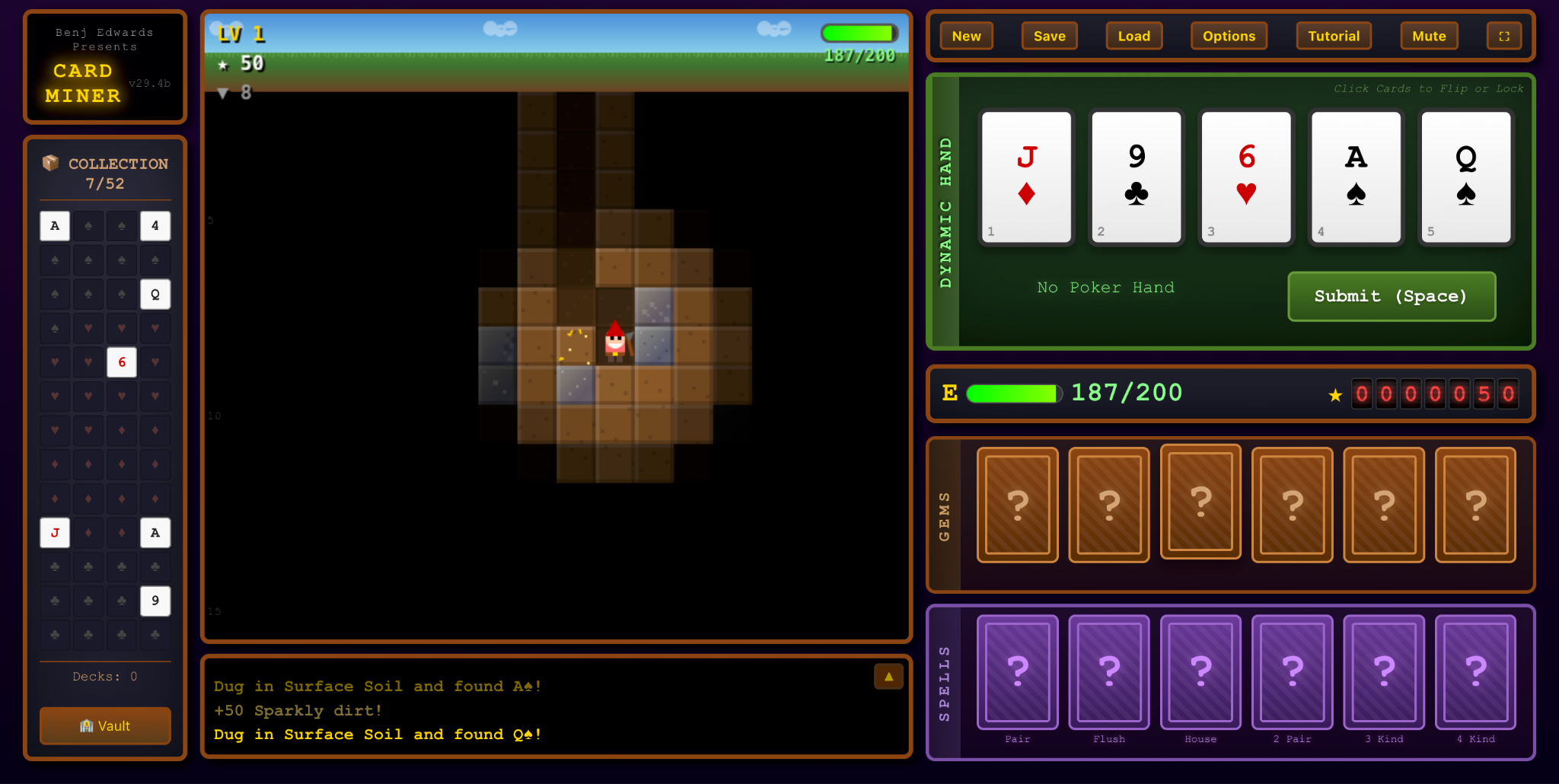
Coding agents have taken things to an entirely new level. Today people can create more ambitious software with far less effort. And while some people are trying to vibe-code serious business software, others are just having fun:
In early August, Tim Kellogg one-shotted a 3D Chutes and Ladders for his kids using Claude Code.
Ethan Mollick, noting that the 1985 text adventure A Mind Forever Voyaging is now open source, used Codex to build an interface that plays either the original or an easier GUI version. Mollick frequently experiments with creating thematic or experimental games using AI agents and shares them online.
In September, Andrew Lee, brother of Understanding AI’s Timothy Lee, used AI to build something like Escape Velocity, the 1990s Ambrosia Software space trader he’d been obsessed with as a kid, complete with pirates, secret missions, and commodity trading.
Notice that two of these three are reconstructions of games their makers loved decades ago. A lot of personal media, it turns out, is nostalgia with a build system.
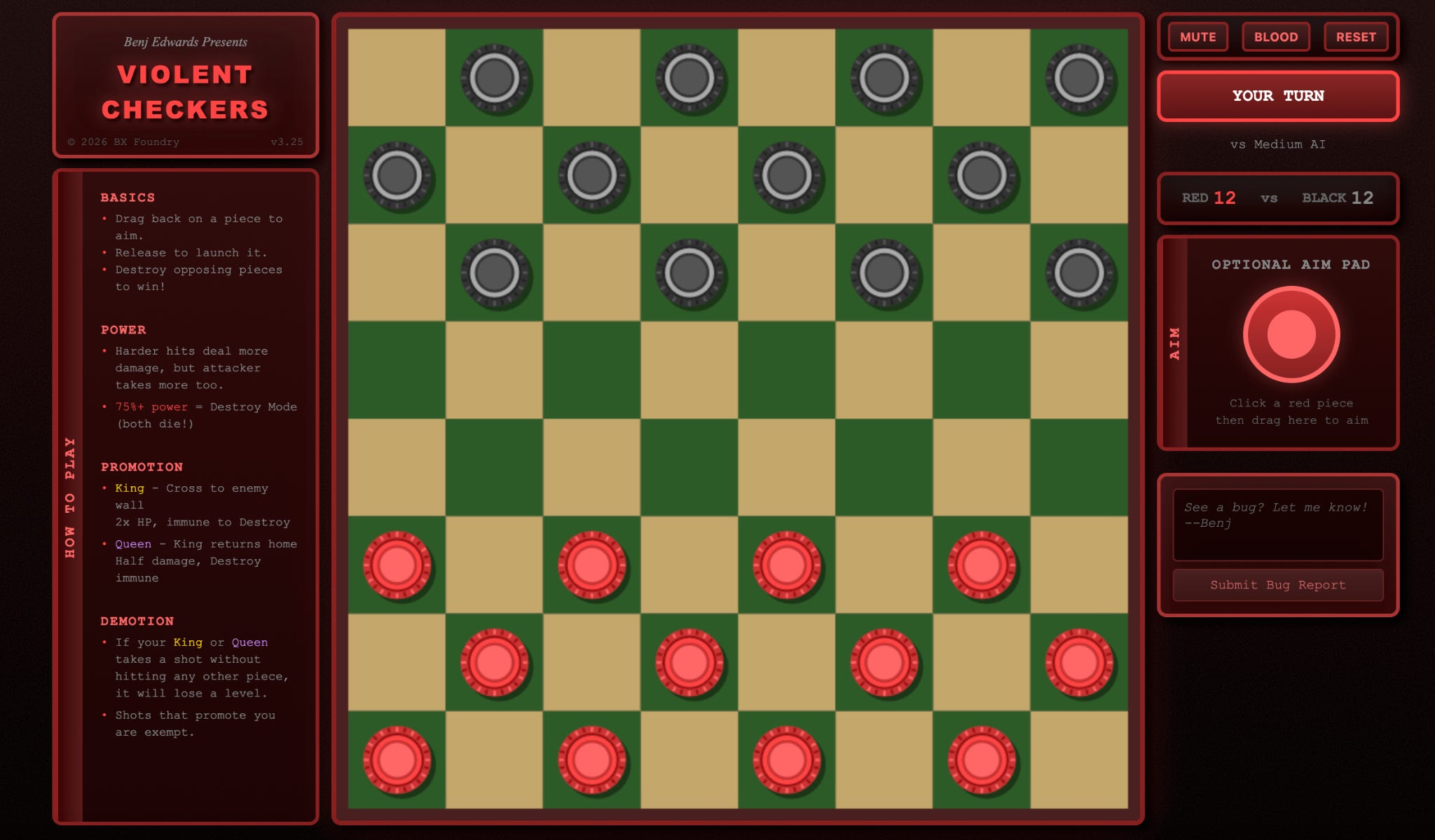
I still buy games on Steam and Nintendo Switch, but I find that I rarely play them. Instead, I now prefer to play games I create with Claude Code based on my own ideas. Games like Violent Checkers, Paydirt Solitaire, and Card Miner are a few of my favorites that I have publicly shared on my website. I also frequently play multiplayer mods of retro video games made using AI and custom NES games — as well as games I have not published and probably never will.
I’m not sure how many people enjoy playing video games they make themselves, but it’s growing increasingly clear that I am not the only one.
Since I began working on this article in January, AI-augmented video game development has accelerated even further with the release of models like GPT-6 Astra and Claude Opus 5.5. These models can create one-shot PlayStation 3-level 3D games, generate impressive ports of games between vintage consoles, and achieve coding feats that feel superhuman (check out my new Christmas-themed Katamari-style game, made with Opus 5.5 and Claude Code). The examples have been flooding social media and causing an existential crisis among some programmers.
As shocking as the new capabilities are now, I think we’ll come to accept personal game creation using AI as a legitimate hobby. In earlier eras, I might have spent my free time programming cellular automata, setting up aquariums, or building plastic model kits. Creating personal media scratches a similar creative itch.
Oversupply and nonsupply
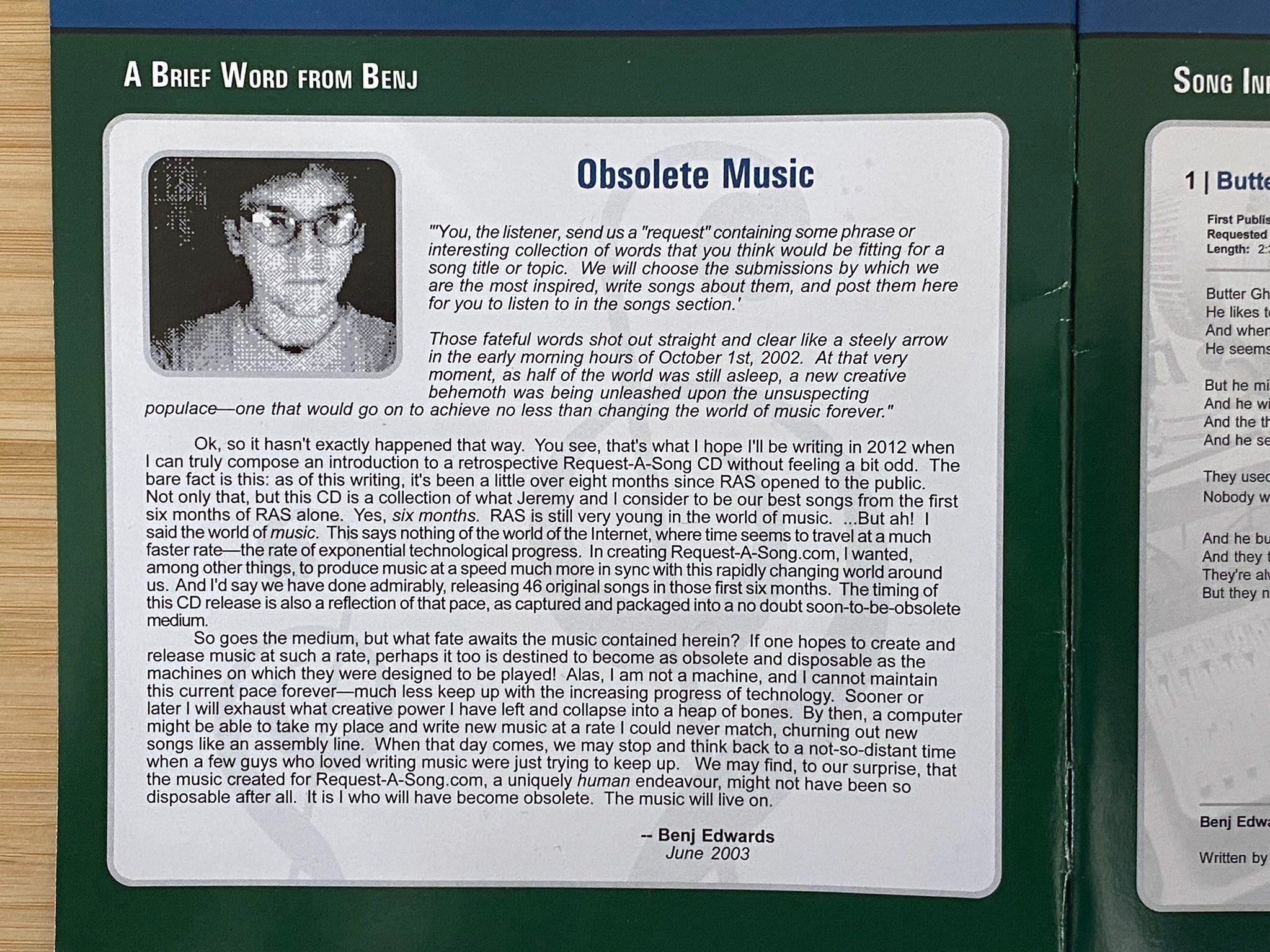
In the earlier days of the Internet, I ran a website called Request-A-Song.com. In a way, it was something like a pre-AI version of Suno. Users would submit ideas — we didn’t call them prompts back then — for songs they’d like to hear. My brother Jeremy and I would choose some of our favorite requests and compose music that matched the request.
Unlike Suno, we delighted in subverting listener expectations by taking requests in unexpected directions. AI just does that by accident.
My brother and I published 134 songs over the course of three years, including a six-month period where I was releasing a new song every week. We counted millions of downloads, got press from USA Today and Billboard, and appeared on the front page of a local newspaper.
In the booklet for my 2003 Request-A-Song CD, I wrote that I couldn’t keep up the pace of rapidly writing and recording music online forever, and that “a computer might be able to take my place and write new music at a rate I could never match, churning out new songs like an assembly line.” I closed with: “It is I who will have become obsolete. The music will live on.”
I’d been thinking about this kind of thing since high school, when I read Ray Kurzweil’s 1999 classic The Age of Spiritual Machines. I explored the implications further in an unpublished 2012 essay that I recently found on my hard drive.
“In the future, computers will be able to do anything a human can do now — a million times faster,” I wrote. “Once we have the software with the capacity to generate aural-realistic music on the fly, it won’t stop there. Soon a machine will be able to compose a song and record it virtually within milliseconds. You will have the entire works of artists generated on the fly.”
“Right now it takes humans a few years to make a blockbuster movie,” I noted. “But if you put that capability into software, as computers speed up, they will be able to complete the task in milliseconds. Imagine having custom photorealistic movies on demand, indistinguishable in quality from a Hollywood blockbuster today.”
How might this impact Hollywood? “Once we have any creative work available on demand, what value will it have? The answer is none,” I stated with undue confidence. “It will be as plentiful as air, and once that happens, intellectual property as a concept and a business model will be completely dead.”
In another unpublished essay from 2015, I imagined overbearing copyright power shifting away from Disney if anyone could make a Disney film at home. Later I would imagine Disney licensing a Disney AI film generator that people pay a subscription to use, like streaming media but on demand.
Today’s generative video models aren’t yet sophisticated enough to make an entire feature film. And the story is similar in most other media categories: creating something that’s both novel and interesting still requires creative effort by humans. I stay heavily involved in producing AI-generated music and video games because AI can’t do a perfect job on its own, although it’s getting better all the time. I also enjoy the creative process, and I get satisfaction out of playing songs and video games I created myself.
But as AI models improve, people like me might become the exception rather than the rule. Most people might prefer passive consumption of entertainment content even if AI makes it trivially easy to make your own.
Yet from another perspective, even the decision to consume media is a (very) small creative act. Saying “I want to watch a Spider-Man movie” is a type of prompt. Traditionally the answer to that prompt has been a big-budget motion picture produced by hundreds of human beings.
But in the near future AI might be able to generate a new Spider-Man film on demand. Users could get exactly the kind of movie they want: “I want to see a Spider-Man film where Spider-Man teams up with Batman.” If it’s really good, maybe that person will share the result with friends. Or the friends might not care, because they prefer their own custom film where Spider-Man teams up with Superman instead.
In reading my 2012 prediction, I believe I got the capability right and the economics wrong. Even if the best movies you’ve ever seen are one voice request away, the typical consumer may prefer consuming mass media as a shared cultural event. On the other hand, those shared cultural groups may grow ever smaller as the culture fragments in new and surprising ways.
The ethics of enjoying personal media
Generative AI is extremely divisive at the moment, and I understand why. It’s disruptive to the status quo along many dimensions. If used poorly in the arts, it can flatten the variety of human expression into a sort of mediocre pablum. If you ask Suno for “country British rock,” it can easily give you the statistical average of every Garth Brooks song and every Beatles song swirled together in a way that feels like an ill-constructed parody.
But as AI compresses the peaks, it also raises the valleys. It allows someone like me with a near-zero budget to bump up my creativity in a way that can make my songs more enjoyable to me, personally, with very little effort.
I understand why people think it’s deceptive to use AI as a substitute for human skill when the audience expects some human authenticity. But is it wrong for me to enjoy listening to an AI rip-off of Parliament-Funkadelic play my stupid song fragment about hauling trash? If no one else hears it, I don’t think so. I think it’s a good time. It may be AI slop, but it’s my AI slop. I am under no illusion that it would win a Grammy or pass muster with a Rolling Stone critic.
Twenty-three years after I predicted my own obsolescence while running Request-A-Song, I now believe that the rise of personal media will not likely result in an “either/or” proposition for the arts but a shift in the proportions. The blockbusters may get bigger and fewer while everything underneath them gets smaller, stranger, and more numerous.
That’s not an original idea by any means. It’s the continuation of a process that began decades ago when three broadcast channels and a handful of film studios fragmented into hundreds of cable channels, then millions of YouTube channels, then billions of individual feeds of social media—a process media scholars have tracked for years.
There are eight billion people on the planet with eight billion perspectives, and we’re increasingly learning more about what we don’t have in common than what we do. The minimum viable audience keeps getting smaller over time; personal media is another step in the same direction.
It’s worth noting that none of these “advances” in media creation and distribution fully replaced what came before. They piled on top of it, which is exactly why I don’t expect personal media to completely replace anything either.
So does that mean everything is OK? Not necessarily.
If any of what I’ve described today becomes the habit of millions, what happens to the hundreds of people whose names scroll past at the end of the latest Spider-Man film? The optimistic version is that mass culture events survive and those jobs survive with them (or perhaps transform to support a new form of media not yet invented), while the fragmentation only happens in the low-budget realm underneath. The pessimistic version is that the same collapse in production cost that let me “hire” an imaginary band eventually reaches the people who make the real thing, which is frankly devastating to conceive.
A third possibility, which I argued in January after burning myself out on fifty AI coding projects, is that most people won’t become unemployed so much as busier than ever. Power tools let more work get done in less time, and the economy tends to demand more productivity to match. The steam shovel didn’t eliminate human workers from construction sites; we gave workers a machine that never gets tired, and then asked for bigger holes. I even wondered in that essay whether knowledge workers would need something like the labor protections unions won a century ago: the tool doesn’t get tired, but the person operating it still does.
So I don’t have a full or ethically satisfying answer to the conundrum of AI dramatically rearranging the creative jobs market or even destroying parts of it in the process. What I have is a throwaway song about hauling moldy garden supplies out of my mother’s basement, arranged by a band that doesn’t exist, that I listen to in the car as I contemplate the decline of my mother from Alzheimer’s disease.
The song is very likely worth nothing to the wider world. You may hate that I even made it. But it reminds me of surviving a traumatic time in my life with some humor and grit, and that’s worth quite a bit to the only person who will ever really enjoy it. That’s personal media.
来源:Understanding AI · understandingai.org