OpenAI Patch the Planet 项目用 GPT-5.6 Sol 发现 PHP 核心 PHP2Shell 漏洞,协调响应约两个月
[AINews] OpenAI’s Patch the Planet program is 1 of 2 parties to discover PHP2Shell vulnerabilities in core PHP affecting 70% of the web, using GPT-5.6 Sol; coordinated response over 2 months
Latent Space AINews 汇总 PHP2Shell 事件:Calif 研究员 Ryan Austin 在 OpenAI Patch the Planet 项目中用 GPT-5.6 Sol。
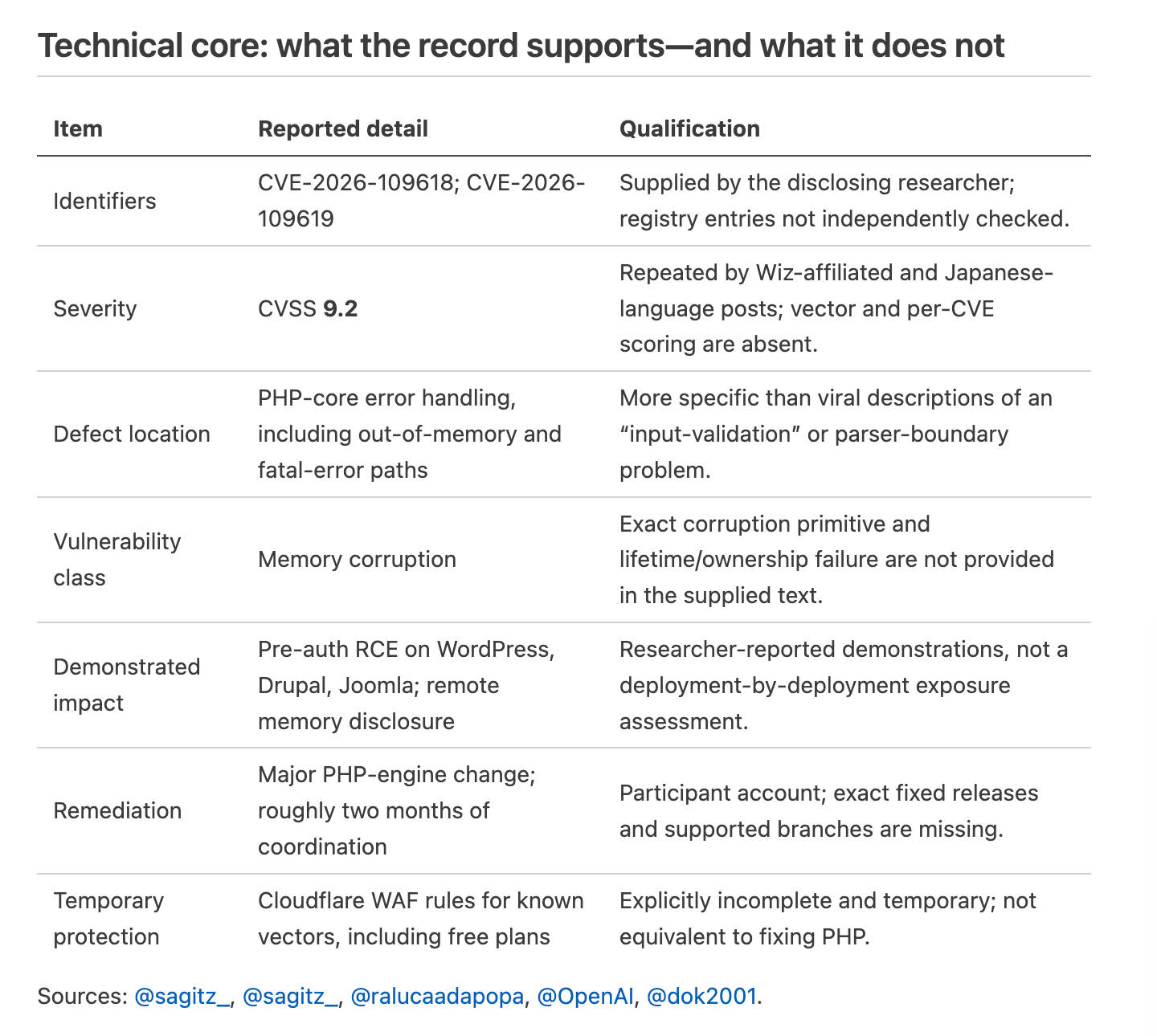
原文梳理了 PHP2Shell 事件中各方说法与证据缺口,读者可以据此分辨哪些结论有原始信源支撑、哪些只是转述。
译文尚不完整,完整内容请切换到原文。
大约2个月前,OpenAI 推出了 面向一线捍卫者的 Daybreak,一项10亿美元的补贴,用于获取 Daybreak 网络模型和产品。这笔资金几乎立即投入使用,因为 PHP 中的重大漏洞被两方独立发现:安全公司 Calif 的研究员 Ryan Austin,作为 OpenAI“Patch the Planet”项目的一部分,于2026年8月使用 GPT 5.6 Sol:
……以及 Wiz,最近被并入 Google Cloud(使用 Gemini 4 Argon 和 GPT-5.6 Sol,以及他们自己的工具 Wiz Atlas)。
所有高调的网络安全披露都至少带有一点营销成分,而这是否是一个严重到堪比 log4shell 和 Heartbleed 等著名漏洞的警报级别漏洞,尚有争议,但可以肯定的是,PHP 生态系统的协同响应是开发者社区以其最理想的形式做出的回应。
我们应该预期,至少在未来一年里都会不断发现这类严重漏洞;但把发现漏洞的人当成替罪羊是错误的做法;相反,我们应该感到欣慰,因为我们关键软件正在接受人类历史上规模最大的安全审计。
2026年10月20日至2026年10月21日 AI 新闻。我们检查了12个 subreddit、544 个 Twitter,没有进一步检查 Discord。AINews 的网站让你可以搜索所有往期内容。提醒一下,AINews 现在是 Latent Space 的一个版块。你可以选择接收/不接收邮件推送频率!
AI Twitter 回顾
头条:PHP2Shell——时间线、核心主张,以及紧急响应背后的复杂情况
发生了什么
研究人员披露了两个 PHP 引擎内存破坏漏洞,并演示了针对主流 CMS 的未认证利用,以及异常广泛的协同响应。
研究人员将这些漏洞命名为 PHP2Shell,并标识为 CVE-2026-109618 和 CVE-2026-109619。他们的技术描述将缺陷定位在 PHP 内部对内存不足状况和致命错误的处理中——而非 WordPress 插件或应用程序的身份验证逻辑。他们报告演示了完整的远程代码执行和“Heartbleed 式”内存泄露。@sagitz_
披露的演示包括针对 WordPress、Drupal 和 Joomla 的预认证 RCE。研究人员的公告还单独声称可对任何 PHP 应用进行远程内存泄露。这些是研究人员报告的利用结果;不应被悄然扩展为声称每个部署都存在完全相同、可立即利用的 RCE 路径。@sagitz_
OpenAI 表示 Calif 的研究人员使用其模型发现了这些缺陷,而二手报道称 Wiz 独立发现了相同的漏洞。帖子指出 Calif/OpenAI 一方使用的是 GPT-5.6 Sol;一个与 Wiz 关联的账号将发现、利用链开发、检测器创建和补丁验证归功于 Gemini 4 Argon。这是一个多方发现的故事,而非某一家供应商独自发现并修复了问题的证据。@TheRundownAI、@steipete、@ralucaadapopa
OpenAI 描述了披露前大约两个月的协同修复过程。它表示该补丁需要对 PHP 引擎进行重大改动,并需要维护者、研究人员、安全厂商和政府之间的协调。一位参与的研究人员证实与 PHP Foundation 合作以支持和加固该补丁。@OpenAI,@itszn13
Cloudflare 在预定补丁发布前部署了初始 WAF 缓解措施。其 CTO 表示,这些规则覆盖了已知的漏洞利用途径,所有客户(包括免费版)均可使用,并随着早期攻击的出现不断更新。他明确称这些规则只是权宜之计,并指示运维人员在 14:00 UTC 打补丁。@dok2001
所提供材料中的 NSA 账号建议为立即更新做好准备——如果无法及时缓解,则应将系统下线。OpenAI 后来的消息称升级已可用;二手报道称细节在补丁发布前已泄露。所提供材料无法确定具体泄露了什么、何时泄露,以及发布计划是否发生变化。@NSACyber,@OpenAI,@TheRundownAI
重建时间线
1. 发现与私下协调:公开披露前大约两个月。
OpenAI 将这项工作归入 Patch the Planet,并表示它领导了一个联盟准备修复和防护措施。其安全研究员 Eric Wallace 补充说,内部团队致力于修补和检测,而不仅仅是披露漏洞,并向政府和外部机构进行了保密的提前通知。Greg Brockman 重申了两个月的协调期。这些是参与者的说法,并非经过独立审计的事件时间线。@Eric_Wallace_,@gdb
区分项目名称很重要:这些帖子将该漏洞与 Patch the Planet 相关联,而研究人员则将安全工作能够开展归功于 Daybreak 模型访问权限。这些是相关但不同的角色——修复倡议与访问机制——并非对同一项目的可互换描述。@OpenAI,@S1r1u5_
2. 提前公开警告与预定补丁窗口。
日语帖子警告运维人员为 10 月 21 日 23:00 JST 的发布做好准备,这与 Cloudflare 的 14:00 UTC 公告一致。其中一个帖子正确地强调,PHP 核心漏洞不能仅仅靠等待插件开发者来修复。另一个帖子将该事件描述为补丁发布后的“15 分钟”竞赛,但那个数字只是预测——并非经过测量的武器化时间。@ds_nakajima,@expokun
3. 发布前的过滤与观察到的攻击活动。
Cloudflare 的帖子是所提供记录中最有力的第一手运营证据:缓解措施已经部署,已知途径已被覆盖,并且“早期攻击”正在出现。它并未说明成功入侵、请求数量、受害者数量、载荷来源,也未说明这些流量代表的是原始漏洞开发还是泄露信息的再利用。@dok2001
4. 研究披露、政府警告与补丁可用性。
研究者的公开帖子描述了漏洞利用演示和错误处理的根本原因。NSA 的帖子呼吁紧急准备和有条件关停。OpenAI 随后表示每个 PHP 站点都可以安全升级。所提供的材料中不包含 PHP 基金会的直接发布公告、确切的已修复版本矩阵、发行包标识符或补丁提交。这一缺失的一手来源层使得无法给出可靠的“升级到版本 X”的指示。@sagitz_、@NSACyber、@OpenAI
5. 据称的提前泄露与广泛的服务中断。
The Rundown 报道称细节被提前泄露。随后一份病毒式传播的汇编补充称,据 Censys 统计,约 150 万台服务器运行着未修复版本;报道的中断涉及荷兰机构、欧洲其他地区的政府网站、Wikipedia、Archive.org、Asana、GOG 等;以及日本首相在 05:55 发出的警告。在所提供的材料中,这些单独的说法均未得到其对应的公告、测量或状态页面的佐证。记录也无法确定每次中断究竟是预防措施、打补丁造成的中断、无关故障还是已被入侵。@TheRundownAI、@fiveoutofnine
SemiAnalysis 另行报道称,日本首相敦促 PHP 运营者立即打补丁,若无法做到则暂时断开连接。其报道将这一应对放在日本已有的入侵浪潮背景中,而非认定是 PHP2Shell 导致了那些更早的事件。@SemiAnalysis_
6. 披露后提供的暴露检查协助。
OpenAI 发布了一个代码仓库,其中包含一项 Codex skill,旨在指导运营者检查其站点是否受影响。这是一种协助工作流,不能替代厂商公告、软件包验证,也不能作为所有存在漏洞的运行时都已被替换的证据。@OpenAI
AI 的角色:可信证据、相互竞争的功劳与未厘清的因果关系
肯定性论据比仅凭基准测试的说法更有力。研究者描述了可用的漏洞利用链、协同的补丁工程、检测器和补丁验证。一位参与其中的研究者称 PHP2Shell 是他们参与发现的最具影响力的漏洞。OpenAI 将其描述为 “防御者窗口” 的一个范例:先进模型在攻击者之前发现缺陷,给防御者留出准备时间。重要的是,其措辞是 “据我们所知”——并非证明此前没有攻击者知晓这些漏洞。@itszn13、@OpenAI
功劳分散在人类、模型和基础设施提供商之间。Calif/OpenAI 和 Wiz/Gemini 作为各自独立的发现主体出现;PHP 维护者提供了上游修复路径;Cloudflare 提供了预发布过滤。Google 还宣传了 Wiz 的测试,其中 Gemini 4 Argon 发现的漏洞数量是基线模型的两倍以上,但所提供的宣传帖未披露数据集、基线、预算或误报核算。这并非对 PHP2Shell 发现性能的独立对比评估。@TheRundownAI,@ralucaadapopa,@Google
研究者访问政策既受赞誉也受批评。一位研究者将 OpenAI 的 Daybreak 访问权限归功于其涵盖 PHP、GitLab、Chrome、WordPress 及其他目标的发现成果组合。另一位则尖锐地将 OpenAI 的经审查访问与 Anthropic 的限制性做法进行对比;关于 Anthropic 贡献了“零价值”的说法是该作者的笼统观点,并未由 PHP 记录所确立。还有一篇帖子批评对 Astra 访问的限制,主张为1000 名经过审查的研究者提供最好的可用模型并施以密集监控,而非僵化的红蓝之分。@S1r1u5_,@migtissera,@S1r1u5_
与之相抗衡的安全理由出现在有报道称 Anthropic 将 Mythos 级模型的广泛访问推迟了四个月,以加强网络防护。这为限制性访问提供了背景,但并未解决其执行是帮助还是阻碍了这一特定的修复工作。@kimmonismus
一波披露本身并不构成一波 AI 导致入侵的证据。所提供的资讯流混杂了防御性发现、供应链攻击、凭证窃取、预防性关停以及不相关的漏洞。Ethan Mollick 将这一刻解读为攻击与防御的加速超出了人类的响应速度;John Allard 则描述了能力的“相变”,同时承认近期许多发现来自白帽项目。两者都是对这一模式的解读,而非事件层面的因果归因。@emollick,@john__allard
操作层面的复杂情况:打补丁、关停,以及“修复一切”的诱惑
这场紧急事件既是发现问题,也同样是分发和归属问题。运营者需要在托管主机、容器、设备、后台工作进程和旧应用程序中定位 PHP;获取合适的软件包;部署它们;重启或替换受影响的进程;并验证正在运行的构建版本。一位运营者描述了自己维护着众多 PHP/WordPress 站点,被测试和更新搞得筋疲力尽。另一位则得出结论,补丁分发协调得很差。@ostrisai,@jd_pressman
部署 WAF 可减少即时暴露,但会产生虚假信心的风险。Cloudflare 自己的声明比后来将所有面向互联网的服务都置于其后的建议更为狭窄:已知攻击途径已被覆盖,防护在不断演变,打补丁仍然是强制性的。代理覆盖、备用入口路径以及源站的暴露情况必须检查,而不能想当然。@dok2001,@threepointone
关机指引是有条件的,并不能证明整个互联网都应断开。所提供的 NSA 帖子建议,在无法立即更新时,应将系统下线,直到能够完全缓解为止。对特定运营者而言,相关问题在于受影响版本状态、暴露情况、可用缓解措施以及继续运行的后果——而不是一条令人警觉的帖子的互动量。@NSACyber
“利用 RCE 自动修补所有服务器”是一项提议,而不是获授权的修复计划。Marc Köhlbrugge 提出了这个想法;J. D. Pressman 建议对尝试此事的实验室或白帽团队给予总统赦免。未经请求的漏洞利用仍然存在未经授权访问、服务中断、错误修复、证据销毁以及跨司法管辖区责任的风险。推测性的赦免并不提供普遍授权,也不能消除民事和外国法律责任。@marckohlbrugge,@jd_pressman
更新速度存在供应链权衡。一篇广泛传播的帖子捕捉到了这一困境:持续更新可能让用户暴露于被篡改的软件包,而推迟更新则会让已知漏洞保持开放。Pressman 认为,除非新漏洞和风险版本发布的速度下降,否则无休止的修补是不可持续的;他还指出,收不到补丁并发现被盗,比收到过多更新更糟。@xeophon,@jd_pressman,@jd_pressman
较长期的替代方案仍是未决问题。Sarah Guo 报告称,自 4 月以来,CVE 从大约每月 4,000 个增加到 15,000 个,并询问形式化验证、更安全的发行版以及没有红队的组织该怎么办。这些数字在此未获独立核实,披露数量也不是成功利用漏洞的直接衡量标准。其他帖子询问对完整代码库进行安全扫描将耗费多少成本,并将挑战重新表述为加固平凡基础设施,而不是只辩论抽象灾难。@saranormous,@saranormous,@teortaxesTex,@mimi10v3
对事件响应团队而言,可站得住脚的顺序是:获取权威的 PHP 和发行版公告,盘点暴露的运行时,在合理时应用临时防护,部署经过认证的修复软件包,验证正在运行的进程,并另行调查漏洞利用的证据。更新修补了一个漏洞;它并不能证明凭据或数据从未暴露。
公众反应:实际谨慎与缺乏支持的升级
谨慎视角强调,相互连接的服务很脆弱,修复可能代价高昂。Joshua Achiam 将此刻比作2020 年 3 月,推测互联网封锁,建议备份有价值的互联网资料,并建议打印重要记录。Pressman 表示,修复成本超出了他的预期。这些是备灾判断——并非即将发生系统性崩溃的证据。纸质副本可能有助于业务连续性,但本身并非防篡改日志。@jachiam0,@jachiam0,@jachiam0,@jd_pressman
对警报持怀疑态度的视角要求给出具体细节。Alex Johnson 认为,关于银行账户被任意清空的警告混淆了未经授权的转账与客户自行授权付款的诈骗之间的区别。他援引美国《电子资金转账法》中关于及时报告的保护条款;但这些保护取决于司法管辖区、账户和具体情形,并非普遍保障。Kelsey Piper 则另行警告长期生活在灭绝式叙事下所付出的心理代价。@AlexH_Johnson,@KelseyTuoc
广义的个人安全建议需要与 PHP 修复区分开来。密码管理器、唯一凭据、强多因素认证、打补丁、运营商防转出保护,以及美国特定的信用或税务身份防护措施,可以减少下游危害。但启用 2FA 并不能阻止对一个未经身份验证的 PHP 引擎漏洞的利用。同样,关于第二天避免所有在线支付的病毒式建议,并没有经过实证的范围评估支持。@peterwildeford,@StillMare_
更广泛的威胁背景是真实的,但不能与 PHP2Shell 混为一谈。SemiAnalysis 报道称,自 9 月 25 日以来已有 18 家日本公司披露了数据泄露事件,包括约 660 万个 Times Car 账户、1118 万条 Burger King Japan 应用记录以及可能多达 2250 万条 Sourcenext 记录遭到暴露。它将有关 AI 辅助扫描和 API 攻击的发现归因于 JPCERT/CC。另一篇帖子引用了 8 月 19 日的一份公告,涉及针对互联网暴露的西门子 PLC 的 AI 辅助工具。这些是各自独立的已报告事件和公告;两者均未证明 PHP2Shell 是其入侵入口。@SemiAnalysis_,@AndrewCurran_
尚未解决的关键证据缺口非常具体:确切的受影响版本和已修复版本;CVSS 向量;部署前提条件;独立发现时间线;发布前泄露了什么;成功利用与扫描的区别;经过验证的暴露数量;以及每次所报道关停的原因和持续时间。所提供的病毒式事件汇编不能仅凭把 PHP、GitLab、LiteLLM、Railway、证书颁发机构故障和政府警告放进同一个叙事中来回答这些问题。@fiveoutofnine
其他新闻
Flint 与自动化研究:本地编码模型、更小团队与科学工作流
Flint 发布,支持广泛的本地部署:Recursive 发布了一款 Apache-2.0 编码 MoE,总参数量约 40B,激活参数量 2.5B,上下文窗口 262K token。LM Studio 表示其在本地需要约 24GB。Recursive 将其定位为前沿云端智能体的设备端补充,而非替代品(发布,规格)。
宣称的结果:Recursive 报告在 Terminal-Bench 2.1 上达到 54.9%,在 SWE-bench Pro v2 上达到 89.7%,在 SWE-bench Verified 上达到 74.2%。这些是发布方声明,并非独立复现(结果)。
性能:宣传的短上下文速度在 MacBook Pro 上超过 125 token/s,在 RTX Spark 上超过 150 token/s。另一位用户在 M5 Max 搭配 int4 MLX 上测得 114–132 输出 token/s;这是对速度的有效佐证,而非受控的能力评估(本地测量)。
研究贡献:Recursive 表示其 Eureka Machine 参与了构思、实现和验证,贡献了稀疏架构选择、低位训练和内核。它声称在几乎不损失质量的情况下将规模缩减了 71%,并在不到四个月内从零开始开发(方法)。
可用性:Day-zero 集成涵盖本地框架和托管访问。vLLM 报告称,在 100K 上下文下,使用 NVFP4 在单块 GB200 上达到 500 tokens/s,且未使用投机解码;OpenRouter 提供免费发布访问(vLLM、OpenRouter)。
Mirendil 声称一名研究员即可进行大规模预训练:Mirendil 表示其首个基础模型由一名研究员在 3.5 个月内完成,计算成本低于 1000 万美元,包括研究实验和最终运行。它披露了异常宽泛的参数范围——Base 为 100B–500B,Large 为 500B–2T,XL 为 2T–10T——而非精确配置。独立评估、后训练结果和 API 访问尚未公布,因此这是一项重要的效率声明,有待外部验证(公告)。
JOLT 联合训练教师和学生:Perplexity 和 NVIDIA 的后训练工作解决了自蒸馏中的一个弱点:特权教师可以利用学生无法获得的捷径。JOLT 使用结果奖励训练教师,同时惩罚其与学生之间过度的分歧。作者报告称,在 MATH 上以 6.5 倍更少的训练 token 达到与 GRPO 相当的效果;加入学生结果奖励的 JOLT+ 在五个评估基准上均优于 GRPO(方法与结果、基准摘要)。
GPT-Rosalind 生成可检验的生物学假设:OpenAI 报告称,数千个智能体在 32 分钟内将数百万个小鼠脑细胞的基因表达结果与文献关联起来。一个提出的机制将 DCTN1 破坏与胆固醇转运受损联系起来;另一个研究小脑神经元中 TSC1 与 TSC2 破坏的差异。这些是供实验后续验证的假设——并非已证明的治疗方法或经过验证的药物靶点(DCTN1 工作、TSC2 后续)。
推理系统:DeepInfer 经济学、原生 TPU 支持与功耗感知容量
DeepInfer 公开生产调度技术:DeepSeek 发布的框架结合了投机解码、动态预填充大小调整、按请求数量和 KV 长度进行解码平衡,以及 CPU 调度与 GPU 执行的重叠。一个特别可复用的思路是,利用预测的草稿接受率和实测硬件吞吐量来调整投机验证长度,使批次更加规律,而不是让慢速副本决定完成时间(技术分析)。
缓存核算:一份部署报告摘要指出,每个预填充加速器每秒处理 150 万输入 token 包括缓存命中,而在 96% 缓存命中率下,不包括命中时为每秒 6 万;解码报告为每个加速器每秒 1.4 万输出 token。这些是性质不同的吞吐量指标(报告摘要)。
经济学注意事项:同一摘要将每加速器小时约 38 美元描述为收入,而非利润。服务器、电力、冷却和人员成本仍不包含在该数字内。
独立基准测试仍存争议:SemiAnalysis 称 DeepInfer 缺席 InferenceX,是因为缺少必要的服务组件,而重建这些组件需要过多假设。其后续的盈利能力对比因混用硬件代际、峰值与非峰值价格、以及收入与利润而受到批评。该批评本身是一份署名的分析,而非已定论的复现结果;实际要求是在比较经济性之前,匹配硬件、工作负载、缓存假设、SLO 和定价(基准测试局限,对比批评)。
TorchTPU 开辟原生 PyTorch 路径:Google 开源了 TorchTPU,用于通过熟悉的 PyTorch 工具进行训练和服务。据报道,SGLang 的插件正为 Meta 的生产推理提供支持,并支持多个当前的开源模型;其自定义 MegaKernel 在批量大小为一、8K 输入/1K 输出工作负载下,为 Muse Spark Open 声称达到 770 decode tokens/s。vLLM-TorchTPU 增加了前缀缓存、推测解码和分离式服务(Google,SGLang,vLLM)。
GTC 强调部署速度和电力利用率:NVIDIA 的 DSX POD 将 AI 基础设施打包为容器化构建模块,其宣传声称容量扩展以天而非月计。更具体地说,Lambda 演示了 19 个 HGX B200 节点在 16 个节点的电力预算内运行,使用的是 DSX MaxLPS。应将部署时间线视为产品宣传,节点结果视为概念验证,而非已交付的全机队容量(DSX POD,Lambda 演示)。
评估完整性 与 Agent 工程:衡量测试框架,而不仅是模型
医学推理暴露完整性与准确性的权衡:Artificial Analysis 修订了 MLCR-AA 的提示词、参考答案和三模型评审团。Sonnet 5.5 和 GPT-6 Astra 以 41.7% 并列,在完整性与准确性综合要求下,没有模型超过 42%。Claude 在完整性上领先;OpenAI 在有记录依据的准确性上领先。修订后的分数与先前方法学不可直接比较(结果,方法学)。
长度混杂因素:一项跨基准分析发现,Claude 的回答比 OpenAI 的长约 4–6 倍;每增加一个主张,就多一次与记录相矛盾的机会。因此,原始评分标准分数、完整性和长度调整后的质量会产生不同的排名(对比)。
SWE-bench Multimodal 面临消融挑战:一项独立调查认为,v2 并不实质性地要求图像;另一位研究人员强调,在不使用图像的情况下运行基准测试是关键的合理性检查。这是对基准测试所衡量内容的实质性批评,而非证明其底层编码任务缺乏价值(调查,消融讨论)。
演化测试框架和接口改进固定执行器:两篇论文强化了围绕智能体优化环境的理由。
SuperMimic 致力于降低人形机器人训练成本:研究人员报告称,使用一块 GPU 训练三小时即可完成 129,514 个动作的训练,而所引用的最先进方案需要 128 块 GPU 训练七天。该机制将学习到的可微世界模型代理与时间反向传播相结合。所称的 GPU 小时数减少 >1,000 倍针对的是这一运动控制训练方案,而非广义的机器人学习(结果,机制)。
智能体产品、检索模型与 API 分发
Claude Duet 进入研究预览:Anthropic 开放了由 Opus-5.5 驱动的主动式助手的候补名单;据报道,初始访问面向美国 Pro 和 Max 用户。示例包括监控 Slack、准备问题以及在收到请求后进行购买。Stripe 描述了 Link 钱包购买以及基于 MCP 的开票、退款和收入分析。可用性处于预览阶段,所提供的帖子中未披露单独定价(Anthropic 高管,访问,支付集成)。
检索产品发布聚焦精度与上下文成本:Cohere 推出了 Pro 和 Fast 两个层级的 Rerank 5。其可选的 Context Focus 返回带评分的段落而非整篇文档,声称在保持准确性的同时将 token 消耗降低多达 41%。另外,ParseBench 报告称 NVIDIA 的亚 1B 参数 Nemotron 3.5 Parse 在其文档理解基准中排名第一(Cohere 功能,可用性,ParseBench)。
Kling 4.0 推广至 API 访问:fal 最初宣布提供 UI/智能体访问,API 支持即将推出;Kling 随后宣布其官方 API 上线。所称的改进集中在复杂运动稳定性、参考一致性和电影级控制方面。较晚的公告取代了早先“API 即将推出”的状态(fal 发布,API 上线)。
企业模型访问扩展,Claude 对其 API 进行版本管理:OpenAI 宣布前沿模型和 Codex 工作流即将登陆 Google Cloud Model Garden。另外,Anthropic 的 API 版本
2026-10-21从 Messages 中移除了temperature、top_p和top_k;新的大版本 SDK 默认使用该版本,而2023-06-01仍受支持。升级 SDK 的团队应明确审查迁移行为(Google Cloud 分发,版本变更,SDK 默认值)。
行业与治理:研究人员言论与公共利益监督
非贬损条款引发审视:引用 BBC 报道的帖子声称,Google 的雇佣合同无限期限制公开批评,从而阻碍了对 AI 安全和军事用途的讨论。前员工的说法和研究人员的评论描述了寒蝉效应。这些是归属于合同和工作场所的指控;所提供的材料未包含公司回应或法律裁决(报道摘录,研究人员说法)。
Anthropic 更新利益治理:Anthropic 发布了年度公共利益报告,并任命实验物理学家、前哈佛大学理学院院长 Christopher Stubbs 加入其长期利益信托基金。这是一项治理层面的进展,与公司的模型评估和产品发布无关(报告,信托任命)。
热门推文(按互动量)
NSA:准备 PHP 更新;若无法缓解则将系统下线 — 80,000
OpenAI:协调 PHP2Shell 的发现与修复 — 19,600
OpenAI:用于检查 PHP2Shell 暴露情况的 Codex 技能 — 10,500
NVIDIA:Microduck 仿真到现实演示 — 7,800
Richard Socher:Flint 本地编码模型发布 — 7,600
OpenAI:GPT-Rosalind 的神经退行性病变假说 — 7,500
AI Reddit 回顾
/r/LocalLlama + /r/localLLM 回顾
1. 开源推理加速:DeepInfer、EAGLE-4、RTX 3090 BF16 解锁
DeepSeek 新品——DeepInfer——(活动量:441):图片是 DeepSeek 在 X 上公告的截图,内容是其自研大规模推理框架 DeepInfer 现已完全开源:图片,GitHub 仓库,X 帖子。DeepSeek 将 DeepInfer 描述为支撑 DeepSeek-V4.1-Flash 的生产推理栈,针对高吞吐、低延迟服务进行了优化,以降低计算成本和能耗;一个链接的知乎来源声称单一集群在非高峰定价下可达到
155 trillion tokens/day,收入约$38/card/hour。 评论者认为这次开源相比 Anthropic、OpenAI 或 Meta 异常激进,有人表示这些实验室“绝不会这样做”。一些用户仍不清楚该框架的实际作用,只是问道:“它能做什么?”一个链接的知乎来源声称 DeepInfer 为 DeepSeek V4.1 Flash 实现了高吞吐、低延迟推理,报告单集群吞吐量为
155 trillion tokens/day,在非高峰定价下收入为$38 per card per hour:

https://zhuanlan.zhihu.com/p/2095560295930508953
。评论者强调,与 OpenAI、Anthropic 或 Meta 等公司相比,这是一次异常激进的公开披露。
一个技术上的担忧是,DeepInfer 究竟是一个真正通用的推理框架,还是主要针对 DeepSeek 自己的模型架构进行了调优。一位评论者指出,与旗舰模型绑定的华丽框架发布往往隐藏着特定于架构的优化,这些优化可能无法顺利迁移到其他 LLM。
帖子中提到的一个性能数字约为
256 tokens/s × 100 users,评论者将其描述为极高的并发服务吞吐量。这意味着 DeepInfer 可能瞄准的是生产规模的多用户推理,而不仅仅是单请求延迟基准测试。
Eagle-4 发布:比 DFlash2 和 DSpark 更快(热度:306):EAGLE-4 是一个源码可得的投机解码栈,使用经硬件/工作负载校准的 draft trees,并为 SGLang、vLLM 和 TokenSpeed 提供
eagle-harness集成路径;目前报告的支持/基准测试集中在 Qwen3.8-27B 上。该帖子称其相较于普通解码的加速为:MTP 提升2.22×,DSpark 提升2.57×,DFlash 2 提升2.80×,EAGLE-4 提升3.59×;而该仓库报告称,在 4× NVIDIA B300 上使用 SPEED-Bench 在单请求并发下获得如下提升:SGLang3.42×,vLLM2.83×,TokenSpeed3.09×;据称在更高并发下提升会缩小(EAGLE-4)。评论者还提到了 Nemotron Bolt 所使用的 LiLiCorr,认为它是一个竞争性的投机解码器,并提供了更细粒度的基准测试报告(论文)。评论者质疑 DSpark/DFlash 的对比是否具有代表性,因为聚合平均值可能掩盖工作负载敏感性——例如 MTP 在代码/JSON 等结构化输出上可能表现更好——并要求按工作负载类型给出细分。另一个担忧是实用性:据报道,EAGLE-4 的 draft model 大约比 DFlash2 大 3 GB,这使得它对显存受限的部署吸引力较低。几位评论者质疑 Eagle-4 相对于 DFlash2 和 DSpark 所报告的加速在不同工作负载下是否具有代表性。其中一位指出,平均结果可能掩盖巨大的方差,因为 MTP 在代码或 JSON 等结构化输出任务上可能表现更好,并要求按工作负载类型细分加速效果,而不是只看聚合基准。
一个实际部署方面的担忧被提出,涉及内存占用:据报道,Eagle-4 的 draft model 比 DFlash2 大约大
3 GB,这可能使其不适合已经达到容量上限、显存受限的本地推理环境。评论者提到了竞争性或相邻的投机解码工作,尤其是 Nemotron Bolt 所使用的 LiLiCorr,其论文据称提供了更细粒度的基准分析:https://arxiv.org/pdf/2608.20530。也有人有兴趣将 Eagle-4 与 HyperQwen 进行比较,或探讨 HyperQwen 能否集成它:https://github.com/syv-ai/HyperQwen。
现在那篇 3090 狂热警告帖就说得通了。(活动:405):该图片是一张 X/Twitter 帖子的截图,声称一个 RTX 3090 “gpu-unlock” 内核/模块可以大幅提升 BF16 张量数学吞吐量,例如
82→155 TFLOPS的 BF16 张量管道和64→99 TFLOPS的 cuBLAS BF16 GEMM,据称是通过移除 NVIDIA 对 FP32 累加张量运算施加的限制实现的。在此背景下,Reddit 原帖询问这是否解释了此前有关“3090 狂热”的警告,以及旧的反挖矿或产品分级限制是否仍可能影响 LLM 工作负载,但评论者指出,合成基准的 BF16/GEMM 提升未必能转化为真实推理/训练加速。评论者对市场炒作角度持怀疑态度:一位称二手 3090 将比 5090 更贵的预测是“妄想”,另一位则链接了此前的反驳,认为该破解并未展示出实际工作负载收益。主流观点较为谨慎:基准测试的说法很有意思,但“快 1.9 倍”可能只意味着小得多的端到端改进。几位评论者认为,传言的 RTX 3090 “破解”被过度炒作了,因为测得的收益似乎仅限于很窄的工作负载切片:大约
10–12%的预填充改进,而不是广泛的1.9x真实世界 LLM 推理加速。一位链接了此前帖子中的 最佳反驳,强调表面上底层的 BF16 收益尚未转化为实际端到端工作负载。提出的一个技术担忧是,BF16 运算可能只占推理时间的一小部分,因此在 RTX 3090 上加速或解锁 BF16 路径影响有限,除非瓶颈确实是 BF16 计算,而不是显存带宽、KV 缓存访问、采样或其他内核。另一位评论者指出,采用与否将取决于该修改能否安全实施,并在 CUDA 和 NVIDIA 驱动更新 中保持稳定。
在价格方面,评论者怀疑二手 RTX 3090 的价值是否会因这一消息而大幅飙升,认为 GPU 定价更多由更广泛的行业供应合同和新卡定位驱动,而非小众 LLM 爱好者需求。一项对比提到,新的 Radeon RX 9700 级 32 GB 显卡约
~$2k可能比被抬价的二手 3090 更具性价比,不过该帖并未对该确切产品命名/价值说法进行深入基准测试。

2. 新的开放模型:Ornith-1.5、Flint、Tiny Voice-Cloning TTS
ornith-ai/Ornith-1.5-122B(Qwen 微调)(活跃度:438):Ornith AI 发布了
Ornith-1.5-122B,这是一个122BMoE 推理模型,基于 Qwen 3.5 / Gemma 衍生谱系从 Ornith-1.0 微调/继续训练而来,采用自我改进循环,通过 RL 联合优化任务生成、脚手架构建和解决方案推演,而非仅使用固定的人工精选任务。产物包括GGUF、unsloth GGUF和NVFP4变体;模型卡声称在编码/智能体基准测试中表现强劲,262K上下文,可选 YaRN 扩展至约1M,并通过 vLLM/SGLang/OpenAI 兼容 API 以及 llama.cpp/Ollama 风格的 GGUF 路径提供 serving 支持。评论者质疑选择 Qwen 3.5 122B 作为基座而非更新的“Next Flash”风格基座,认为它可能已经落后于更新的架构。一个技术上的担忧是推理速度:由于它基于 Q3.5122B,拥有A10B激活参数且缺少稀疏注意力,一位评论者估计它将比拥有A6B激活参数的 Q3.8fn 风格模型大约慢2×。一位评论者指出,该微调基于 Qwen 3.5 122B,这意味着对
q3.8fn用户而言是 A10B 而非 A6B 的行为,并且 没有稀疏注意力,他们估计这会使该配置下的推理大约慢2×。对于基座模型的选择存在技术性怀疑:一位评论者询问为什么没有基于 Ornith Next Flash 构建,认为虽然 Qwen 3.5 是一个强大的基座,但相对于更新的替代品,它已经“被甩在了后面”。
RecursiveSI/flint (40B A2.5B) · Hugging Face(活跃度:784):RecursiveSI/flint 是一个 Apache-2.0 仅解码器 MoE 编码智能体模型,托管在 Hugging Face 上,总参数量
39.8B,但每个 token 仅约2.5B激活。它使用49层,每个 MoE 层有256路由专家,每个 token 选择6个,混合滑动窗口/全注意力,以及有文档记载的262k上下文;Recursive 报告在 Terminal-Bench 2.1 上达到54.9%,在 SWE-bench Pro v2 上达到89.7%,在 SWE-bench Verified 上达到74.2%,目标是在 B300/H200 GPU 上通过 SGLang serving,并支持 OpenAI 兼容的工具调用。评论者将其描述为人们希望从 Qwen 3.8 得到的“35B-A3B”级别模型,但指出 Qwen3.8-27B 的存在使这次发布显得不那么令人惊讶;除此之外,基准测试截图是主要的技术讨论点。评论者将 Recursive Flint 定位为一个
40BMoE,仅有2.5B激活参数,大致匹配一些用户想要的“35B-A3B”稀疏模型级别,但现在要与像 Qwen3.8-27B 这样更新的小激活 MoE 竞争。该讨论串指出,如果没有 Qwen 最近的发布,这很可能会被视为一次重要得多的大事件。NVIDIA 在柏林 GTC 的技术公告将 Flint 定位为专为 RTX Spark 优化的本地编码模型,声称在
220 tokens/s上超过64GB RTX Spark,并在包括 SWE-Bench Pro v2、Terminal-Bench 2.1 和 SWE-bench Verified 的智能体编码基准上表现强劲:https://blogs.nvidia.com/blog/local-ai-gtc-rtx-dgx-spark-station-sync/NVIDIA 表示 Flint 是使用 Recursive 的 Eureka Machine 构建的,这是一个自动化 AI 研究循环,能够提出想法、实现想法、运行实验并选择后续方向。所引用的帖子声称,该系统生成了专用内核,使 Flint 在 RTX Spark 上的生成速度提升了
55%,且未改变模型权重,并指出其为 Apache 2.0 开放权重,同时支持通过 NeMo Automodel SFT/LoRA 和 NeMo RL GRPO 进行后训练。
支持语音克隆的 Pocket TTS 现在仅有 190 万参数(活动:561):Kyutai 发布了 Pocket TTS-small,将 CPU 实时语音克隆 TTS 栈从约 ~
100M参数压缩到18.2M、6.9M和1.9M变体。该压缩流程使用了来自约 ~300M教师模型的蒸馏、单次烘焙的无分类器引导、基于 PCA 推导的64-D骨干–头部潜在接口、结构化 transformer 剪枝、单独的骨干/头部/编解码器蒸馏,以及可选的奖励微调;报告称 CPU 吞吐量在18.2M模型上达到约 ~9.9×实时,在1.9M模型上达到约 ~25×实时,其中18.2M模型在 WER/UTMOS 上与原模型持平或略优。评论者较少关注压缩方法,更多关注发布模型/演示中一个明显的脏话过滤器——例如“What the fuck”被渲染成“What the dee”——不过一条更新称团队已修复该问题。其他人则要求提供更严格的基准测试,涵盖自然度、实时因子和跨说话人语音相似度,尤其是针对完全本地推理。多位用户报告 TTS 输出中出现了明显的文本审查/回归:像“What the fuck”这样的短语被合成为“What the dee”。最高赞评论者后来指出,团队已处理该问题并发布了修复,表明这很可能是有意之外的模型/分词/过滤行为,而非永久性的策略选择。
一位评论者强调,标题中的参数数量——
1.9M参数——令人印象深刻,但要求提供具体的评估数据:自然度、实时因子和跨说话人语音相似度。他们强调,小型 TTS 模型最吸引人之处在于,它们能在不牺牲说话人克隆质量的情况下保持完全本地推理。一位用户报告非英语语言支持很差,声称非英语输入实际上被渲染成英语而非目标语言。这表明尽管有更广泛的 TTS/语音克隆宣称,其多语言能力可能较弱或缺失。
3. AI 硬件供应紧张:Nvidia 订单与 HBM/DRAM 定价
独家:字节跳动、阿里巴巴、腾讯下达价值超过350亿美元的英伟达芯片订单(热度:1047):路透社报道称,字节跳动、阿里巴巴和腾讯已下达超过350亿美元的英伟达芯片订单(路透社)。Reddit帖子将此描述为中国订购约
3M块RTX PRO 5500显卡,单价约$11,400,很可能针对大语言模型推理和AI视频生成,而一位被引用的消息人士称,英伟达可能仅能交付所请求数量的5–10%,并且2027年全球最多只能生产3M块RTX PRO 5500显卡,而中国客户的需求超过6M。评论者认为,供应限制意味着这一头条订单量不太可能全部交付,一些人猜测随着数据中心需求占据主导,英伟达可能会降低利润率较低的工作站级显卡的优先级。也有人怀疑未来几代GPU是否会让当前的RTX PRO显卡对本地LLM用户变得可负担,不过一些人希望数据中心更新换代周期能压低二手市场价格。评论者强调了一个据报道的严重供需错配:英伟达可能仅向合作伙伴分配所请求数量的
5%–10%,一位消息人士称其2027年全球最多能生产3 million块RTX PRO 5500显卡,而中国客户订单超过6 million。这意味着这$35B+订单簿可能受到严重的供应限制,而非完全可交付的需求。一则价格更正指出,隐含单价约为每块显卡
$11,400,而非$11.40,使订单规模与高端专业/数据中心GPU定价相符。另一个技术层面的担忧是,高利润率的企业需求可能使英伟达连$16,000RTX 6000 Pro这样的显卡都不愿优先于数据中心分配。几位评论者推断,GB202级芯片可能被转用于专业或符合出口规定的SKU,如RTX PRO显卡,从而减少RTX 5090等消费级GPU的供应。潜在担忧是,数据中心/专业需求可能持续挤占游戏GPU供应,直到新一代产品将需求从当前芯片转移开。
做好准备,GPU涨价即将到来——>三星2027年HBM产能已100%售罄——预计明年HBM价格将飙升200%,DRAM价格预计将出现两位数涨幅(热度:1227):GSMArena报道称,三星据称已通过与大科技客户签订的大额多年期合同,预售了明年通用DRAM产量的约
70%和HBM产能的100%。由此产生的内存供应紧张预计将推动HBM价格上涨150–200%,DRAM价格在2027年第一季度出现两位数上涨,增加GPU/AI加速器以及未来Galaxy手机等下游设备的BOM压力。评论者预计HBM紧张将加剧消费级/本地AI GPU的可负担性问题,同时指出这一依赖循环:前沿模型需要超大规模GPU集群,但本地推理用户却在争夺同样受限的内存供应。一些人认为,稀缺可能迫使优化转向更小、更高效的模型和更长的硬件生命周期。一些评论者将报道中的三星2027年HBM售罄以及预期的HBM/DRAM涨价,与本地AI硬件经济性的恶化联系起来:本地推理用户需要GPU,但超大规模云厂商和AI实验室同时在为训练和数据中心扩张吸收供应。一位评论者指出,在配套数据中心容量建成之前,GPU的采购似乎已在加速,这意味着囤积库存可能会使消费级/专业消费级GPU供应在数年内持续受限。
有人提出了一个技术经济观点:随着GPU和内存价格上涨,而部分云AI服务变得更便宜,本地AI设备与云端推理的盈亏平衡点已经外移。该评论者具体指出,这一现象被MoE模型放大,因为数据中心能够比单台本地机器用昂贵的、高显存占用的硬件所证明的合理性更高效地在众多用户之间复用稀疏专家激活。
一位评论者认为,硬件稀缺可能会推动模型侧的优化,激励更小、更高效的模型,而非单纯扩大参数规模和内存带宽。其含义是,高昂的HBM/GPU价格可能会加速压缩、量化、蒸馏、稀疏架构以及推理效率改进方面的工作。
When will we see these changes? --> China Is Doubling RAM Production to Keep Everyday Gadget Prices from Skyrocketing (Activity: 402): The post asks when consumers will see price effects from China reportedly doubling RAM/DRAM production, likely via domestic suppliers such as CXMT, in response to rising memory demand. Top technical comments argue the effect will be gradual: new DRAM capacity ramps over quarters/years, is absorbed by latent demand in areas like edge compute and datacenters, and may mainly reduce the rate of price increases rather than create an obvious consumer price drop. Commenters are skeptical that global buyers will see near-term savings: one view is that Chinese output will mostly satisfy domestic Chinese demand, reducing China’s imports rather than flooding export markets. Another argues manufacturers will not abandon high-margin enterprise/datacenter sales for low-margin consumer DRAM, so end-user gadget prices may remain elevated.
Several commenters emphasized that additional DRAM capacity will appear gradually rather than as a visible price drop: new fabs ramp over years, and added supply may be absorbed by latent demand from edge compute, datacenters, and consumer devices. One prediction was that the main near-term effect is slower price inflation rather than cheaper RAM, because vendors are unlikely to abandon high-margin enterprise/AI demand for low-margin consumer sales.
A detailed supply-chain comment cited CXMT’s target of
600,000 wafers/month by 2028as the relevant timescale, arguing that memory capacity expansions triggered by the AI boom will start arriving from late 2025 onward and continue through 2030. The commenter also noted parallel global expansions: U.S. fabs in New York, Idaho, and Indiana tied partly to the CHIPS Act; Samsung adding 4th and 5th facilities at its memory hub; and SK Hynix investing roughly35 trillion wonin its Y2 plant plus19 trillion wonin its F17 fab.Another technical/economic point was that China’s increased DRAM output may primarily displace imports rather than flood global consumer markets: CXMT could satisfy domestic Chinese demand first, especially with aggressive datacenter construction. Commenters framed memory manufacturing as highly cyclical and capital-intensive, where overbuilding can turn record profits into bankruptcy because trillion-dollar-scale fabs cannot be quickly repurposed or liquidated if demand falls.
Less Technical AI Subreddit Recap
/r/Singularity, /r/Oobabooga, /r/MachineLearning, /r/OpenAI, /r/ClaudeAI, /r/StableDiffusion, /r/ChatGPT, /r/ChatGPTCoding, /r/aivideo, /r/aivideo
1. Claude Agents for Personal and Data Workflows
Claude Duet: Anthropic just casually dropped the personal assistant calling it a proactive agent. This is the response to Muses, Bots and Dots (Activity: 1306): The image is a screenshot of an X/Twitter announcement from Claude introducing Claude Duet, a research-preview app positioning Claude as a proactive personal agent rather than a purely chat-based assistant. The post claims Duet can surface items needing attention, complete requested tasks asynchronously while the user is away, and request confirmation before acting on the user’s behalf; one commenter notes it will reportedly be available on the
$20plan. Commenters were mixed: one said this matches how they already use Claude and questioned what differentiates Duet from other agent/app concepts like Muses, Bots, and Dots. Another top comment was a non-technical joke and adds no substantive technical context.Commenters noted that Claude Duet appears to be included in Anthropic’s existing
$20/monthplan, suggesting Anthropic is positioning the proactive-agent/assistant layer as part of mainstream paid Claude usage rather than a separate enterprise-only product.Several technical critiques argued that current “assistant” launches from Anthropic/OpenAI-like vendors still look like thin chatbot wrappers over different frontier models, rather than fundamentally new agent systems. Users questioned what differentiates Claude Duet from existing personal workflows using Claude, Muses, Bots, or similar assistant abstractions.
One commenter argued that the missing piece is not necessarily model capability but structured personal-data integration and product orchestration: a useful assistant would need better schemas, context management, and integrations with external services. They suggested the required technology already exists, but needs to be packaged into a coherent assistant experience rather than another generic chat UI.
I used Claude to fix my Samsung TV (Activity: 3894): A user reports using Claude as an interactive agent to diagnose a Samsung TV as Tizen rather than Android, then work around the lack of webcam access by serving a local web page, generating a local-server QR code, and using the phone camera to capture TV screenshots every
4sfor visual feedback (QR screenshot). The agent allegedly spent ~30 minchanging privacy/telemetry settings, deleting the Samsung advertising ID, disabling unused apps, rearranging icons, then building a custom “Apple TV-style” launcher/home-screen app plus a companion settings app for shortcuts/backgrounds (launcher, settings UI). A top commenter describes a similar custom TV launcher pipeline for guests: pre-arrival preference intake, personalized Plex/media/news surfacing, music/background/welcome screens, itinerary/weather display, and Home Assistant controls for outdoor lights, pool aerator, and misters. Commenters were mainly surprised that the user even attempted this level of autonomous TV debloating/customization with Claude; one framed it as a practical example of agentic UI automation beyond standard coding assistance. The cat-video detour was treated humorously rather than as a technical failure.A commenter described using Claude to build/replace a Samsung TV launcher with a custom guest-oriented interface: questionnaire-driven personalization for Plex movies, TV/news station presets, background music, weather, itineraries, and local recommendations. They also integrated the launcher with Home Assistant so guests could control outdoor lights, pool aerator, misters, and other smart-home devices directly from the TV home screen.
Another commenter suggested avoiding a custom Claude-driven workflow by installing
cleanyourtv, a GitHub project with roughly15,000stars aimed at cleaning/debloating smart TVs. They framed it as a faster, lower-token alternative to having Claude manually guide or generate the TV-fixing process.One technical detail called out was the removal of the TV’s Ad ID, implying the original Claude-assisted fix included privacy/debloating steps rather than only UI tweaks. This was viewed as a notable privacy-oriented modification for a Samsung smart TV.
I replaced my Samsung TV’s home screen with Claude Code (Activity: 1069): The image shows a custom Samsung TV launcher replacing the stock ad-heavy home screen with a minimal web-style interface: clock/date, selected app tiles, console shortcuts, settings, and remote-control hints. The author says Claude Code helped build the launcher and speed iteration by mocking Samsung TV APIs in a laptop browser; Home-button takeover reportedly uses a CleanFrame-like helper that edits undocumented TV settings, tested only on a 2022 Samsung Q70B. Code is available on GitHub, with a longer write-up. Comments were skeptical and polarized: one commenter praised the project as a way to avoid Samsung/LG telemetry and ads, while others suspected spam/scam reposting or dismissed it as repetitive.
Commenters raised privacy/security concerns around proprietary Samsung/LG smart-TV software, arguing that an open-source replacement UI/OS could reduce vendor telemetry and unwanted tracking. One technically relevant caveat was the risk that “vibe-coded” TV firmware or home-screen replacements could brick devices if deployed without understanding the platform’s boot/update constraints.
A security-focused thread warned that encouraging users to run unvetted TV code could create a large attack surface: compromised replacement launchers or scripts could enable synchronized remote control of many TVs, e.g. forcing playback of attacker-chosen video across devices.
One user asked whether replacing the Samsung home screen produced measurable latency improvements, noting that stock TV launchers feel “slow as a pig.” They also referenced using Claude to install Jellyfin, suggesting interest in whether an AI-generated TV launcher could improve responsiveness for local media workflows compared with OEM smart-TV software.
I handed Claude Code a database of 11 million news articles, it found some weird patterns (Activity: 1604): The image is a technical dashboard screenshot, not a meme: it shows CLSTR’s dark-themed “The world right now” map, where a news-ingestion pipeline visualizes current global event volume by country. In the post, the author says the system processes ~
100karticles/day from40k+sources in40languages, clusters them into events, and exposes derived analytics after11,079,667articles; the screenshot reports2,703events across161countries in the last3hours and highlights a major cluster, “France implements curfews amid widespread civil unrest,” with673articles. The important clarification is that Claude Code did not read 11M full articles; it queried/exported aggregated cluster metadata produced by the author’s pipeline, which uses embeddings, heuristics, and an LLM judging step. Commenters debated whether the methodology supports the claims: one skeptical thread argued Claude likely only wrote heuristic analysis code and that source-selection/clustering biases could dominate the observed patterns. Others were more optimistic, viewing this as an example of LLM agents helping surface large-scale patterns in real-world data.Several commenters questioned whether Claude Code actually processed
11Marticles directly, arguing that full LLM-based analysis at that scale would be prohibitively expensive and slow. A more plausible implementation would be Claude writing auxiliary code or heuristics to aggregate/search the corpus, but commenters warned that such heuristics need to be documented because they may dominate the results.A major methodological critique was the lack of detail on data collection, source selection, and sampling bias. Commenters noted that if sources came from Google News or another aggregator, the observed patterns could reflect ranking, regionality, click-history personalization, or source-availability bias rather than real media behavior.
Commenters also flagged potential language/source coverage issues, including the claim that unknown-language items were labeled as English and the apparent absence of major non-English corpora such as Russian, Chinese, or Korean. They argued that without source documentation and language-labeling validation, conclusions about global news patterns would be technically weak.


2. Robotaxis and Humanoid Robotics Scale-Up
Waymo’s robotaxis had 95% fewer serious crashes than humans. Now it plans a fleet of 20,000 cars (Activity: 1457): Waymo’s latest safety data reports
271.3Mrider-only miles with0.01serious-injury/fatal crashes per million miles versus a modeled local human benchmark of0.21/M, i.e. ~95% fewer serious crashes, plus ~82% fewer injury crashes. An IIHS analysis of 2021–2024 federal crash data over ~50Mdriverless miles found directionally similar reductions—68% fewer police-reportable crashes and 81% fewer injury crashes—but noted reporting limitations and an Austin result that was slightly worse than the human benchmark. Semafor reportedly says Waymo plans to scale from ~4,000vehicles to20,000by end-2027, partly via a$5Bdebt raise. Commenters debated whether the benchmark is apples-to-apples: supporters argued serious crashes are common enough that the reductions are meaningful and that Waymos are rarely at fault, while skeptics noted Waymo’s current ODD is mostly dense urban, lower-speed, limited-highway driving—unlike rural/suburban or high-speed highway exposure where many severe crashes occur.A commenter claiming experience in OEM crash-safety engineering argued that the reported Waymo safety results are consistent with a decade of AV studies: human driving is a high-risk daily activity, while autonomous systems have generally shown lower serious-crash rates. They emphasized that the reported metrics appear to be based on total crash volume rather than fault, noting that Waymos are often involved in crashes caused by human drivers rather than being the initiating party.
Another commenter raised an exposure-bias concern: Waymo vehicles reportedly operate mostly in dense urban environments and rarely on highways, where high-speed crashes and severe injuries are more common. They suggested that the
95% fewer serious crashesclaim may not generalize to rural, suburban, or frequent highway operation where speeds exceed50 mphmore often.A commenter noted that Austin-specific crash-rate comparisons may be statistically weak because the study period allegedly included only
2Waymo crashes there. They argued this sample size is too small to support strong conclusions about whether Waymo is safer or less safe than human drivers in that market.
Unitree’s newest robot: H2-X Kung Fu Legend Guardian (Activity: 3907): Unitree announced the H2-X “Kung Fu Legend Guardian”, apparently a more rugged/high-force H2 humanoid variant, claiming maximum endurance of ~
8 hoursand framing it as a “serve and guard” platform in its X post. The post contextualizes it alongside other Chinese humanoid combat/entertainment robots, notably Engine AI’s T800, used in fighting-tournament demos per this writeup; the Reddit-hosted video itself was inaccessible due to a403 Forbiddenblock. Top comments focused less on specs and more on safety/dual-use concerns, joking that the demo robot appeared to shove a child with more force than a slow car would and sarcastically hoping the technology would not be misused.
3. Open-Source AI Model and Kernel Policy Updates
Fibo 2 Edit is what Klein 3 should’ve been. (Activity: 1189): Reddit user reports Fibo 2 Edit (HF model) as a fast, out-of-the-box “uncensored” image editing model with no observed color drift/quality loss in simple edits, attributing some quality gains to the Flux 2 VAE. They link experimental ComfyUI support via PR
Comfy-Org/ComfyUI#17240, but later update that it struggles with complex prompts and multi-reference edits, and is “not better than Qwen, just faster.” Comments frame Fibo 2 Edit as potentially “best edit model so far” largely because it is uncensored, with a side debate implying censorship may degrade model utility. Another commenter highlights rapid open-weight image-model progress, citing upcoming/available models like Ideogram 4, Krea 2, Qwen 2.1, LTX, and quantized Hunyuan Image 3 running in ComfyUI on consumer hardware.Users highlight Fibo 2 Edit as a strong image-editing model and note that it is reportedly uncensored, with one commenter claiming it is the “best edit model so far.” The discussion frames this as part of a broader trend where less-restricted image models are perceived to outperform more heavily filtered alternatives in practical editing quality.
A technically relevant limitation was reported around output resolution: Fibo 2 Edit allegedly downscales source images to roughly
1MP, then processes them through the Flux 2 VAE, causing blurry results. This suggests the model or current pipeline may be bottlenecked by preprocessing/VAE resolution handling rather than edit semantics alone.Commenters mention interest in ComfyUI support and broader open-weight ecosystem momentum, citing models such as Ideogram 4, Krea 2, Anima, Qwen 2.1, Moss Image, Ming Image, Minimax H3, LTX, and Hunyuan Image 3 quantized. The latter is noted as potentially runnable in ComfyUI on consumer hardware, implying quantization is making larger image models more accessible locally.
As of 3 hours ago, the Linux Kernel no longer requires the usage of AI to be declared for new code submissions. (Activity: 1071): A screenshot of
torvalds/linuxshows commit14c8977by Linus Torvalds, merging Linux documentation updates that include removal of the prior “Assisted-by” requirement for new kernel submissions. In context, this means contributors no longer need to explicitly declare AI assistance when submitting code to the Linux kernel, shifting the policy away from mandatory AI-use disclosure. Comments were split between approval and anticipated backlash: one commenter argued that assumptions like “AI code is all slop” are outdated, while another expected a community meltdown. A practical commenter suggested they might now submit a long-standing local driver fix using Claude, implying the change could lower the barrier for some contributors.One commenter notes they have been carrying a local kernel patch across releases for a recurring driver bug affecting some motherboards with a specific chip, and the relaxed AI-disclosure rule may make them more likely to upstream the fix using Claude. The technical implication is that reducing disclosure/process friction could increase submissions of small, hardware-specific fixes that otherwise remain private local patches, though the comment does not identify the driver, chipset, or exact bug.
来源:Latent Space · latent.space