中国AI出口管制草案解读:开源权重模型不在封禁之列
✅China’s Draft AI Export Controls Don’t Block Open-Weight Models
中国商务部和科技部10月16日发布技术出口限制目录草案,首次覆盖先进大模型、AI智能体和大规模算力集群,公开征求意见至11月15日。禁止出口的包括使用核心数据训练的模型、国防等高敏感应用智能体和AI驱动的恶意代码技术;受限类别设三条阈值:训练算力≥10²⁶次浮点运算、参数≥2万亿、或全球前十的公开评测能力。
原文逐条拆解中国AI出口管制草案的阈值与豁免条款,澄清开源权重不受限的误读,并对比各国管制路径。

On October 16, China’s Ministry of Commerce (MOFCOM) and Ministry of Science and Technology (MOST) released a draft addition to the country’s catalogue of technologies restricted or prohibited from export.
For the first time, the proposal covers advanced large AI models, AI agents and massive computing clusters. Anything on the list would either be barred from leaving China or require a license.
The draft names 40 key technologies across AI, biopharma and photovoltaic technologies (used to manufacture solar panels). 14 are prohibited while 26 are restricted and would need permission to export. The ministries are taking public comment from Oct 16 to Nov 15, therefore this is a draft, not a final rule.
While the draft is under consultation, a temporary registration is required for exports of the listed technologies, including transactions underway but not yet completed. It covers overseas ownership transfers and licensing, as well as changes that place domestically held technology under foreign ownership or actual control.
You can find the original Chinese text here. The Geopolitechs newsletter published an insightful analysis ended with a few great open questions. In this issue, I’ll focus primarily on the listed AI models, agents and computing infrastructure and debunk some myths circulating on social media.
What would be banned
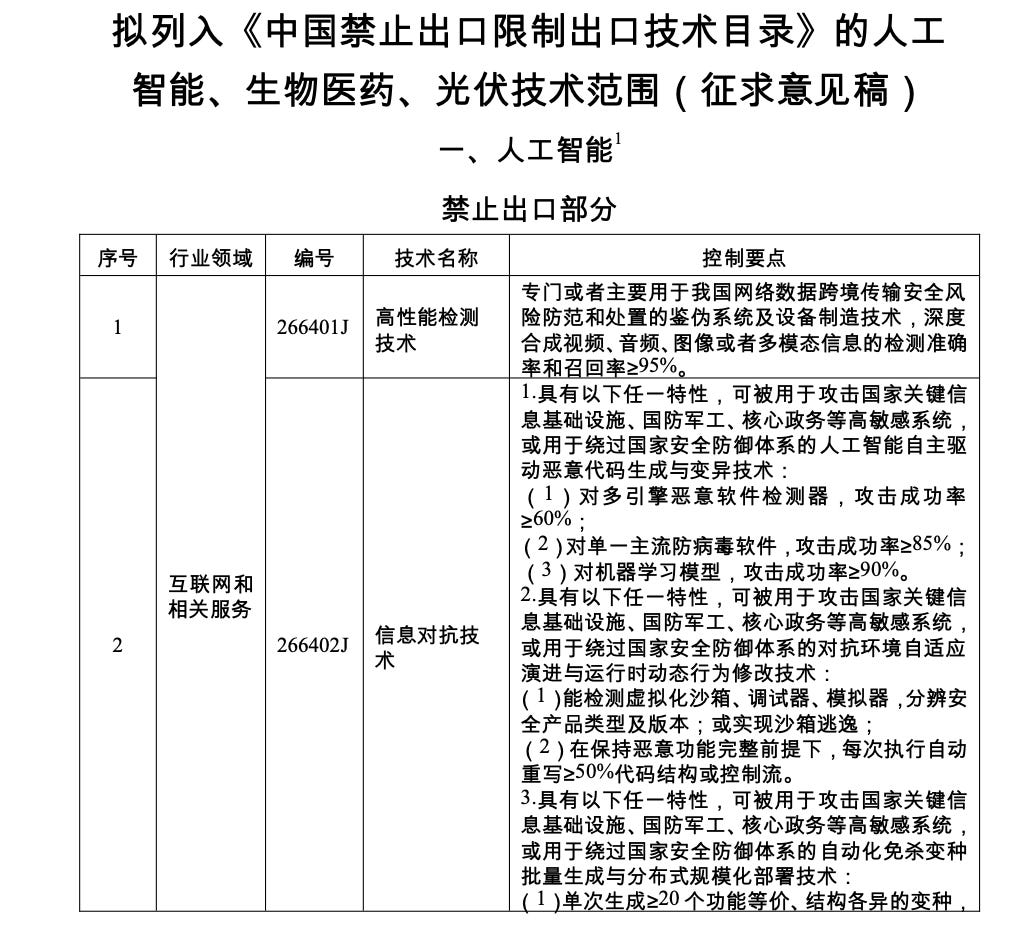
The prohibited AI technologies covers models trained using China’s legally designated “core data,” which refers to data involving national security, the lifelines of the national economy, major aspects of people's livelihoods, or major public interests.
Also prohibited from export are agents for highly sensitive applications (like national defense and military), advanced offensive cyber technologies featuring AI-driven malware generation and mutation, and certain deepfake-detection technologies for cross-border data security.
What would need a license
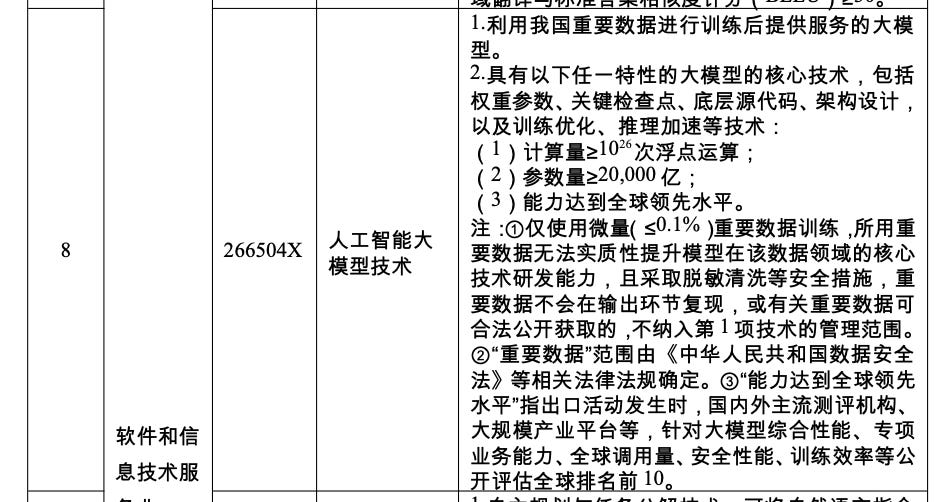
Models trained on “important data” fall into the restricted category, subject to exceptions. This compromise of important data could endanger national security, economic operations, social stability, or public interests.
So does any model that meets one of three thresholds:
Training computation ≥10²⁶ floating-point operations.
Parameters ≥2 trillion.
Globally leading capability, defined through top-10 public assessments at the time of export.
Those assessments can include specialized capabilities, usage, safety, or training efficiency—not just overall performance. Covered technologies include weights, checkpoints, source code, architecture, and training and inference optimizations.
Agents are judged on autonomy and intended use. Restricted agents include systems meeting combined thresholds for decomposing tasks into at least 20 steps, coordinating at least 60 agents, or integrating at least 200 tools, alongside specified accuracy, efficiency, and success rates. Advanced strategic decision-making agents are also covered.
Other restricted AI-related technologies include AI and memory-chip design, computing systems with more than 10,000 AI accelerator cards, AI-assisted vulnerability discovery and exploitation, and advanced detection, voiceprint recognition, and translation.
The draft adds two explicit footnotes.
First, technology already in the public domain through open source, academic publication, or similar means is outside the export controls’ scope.
Second, for restricted AI technologies, open-source release, Chinese companies’ self-built and self-operated overseas computing centers, overseas chip fabrication, joint R&D using overseas resources, and international standards work would receive automatic licensing or other facilitation. This means the draft export control would not block open weight releases.
MOFCOM’s press spokesperson said that most AI technologies would remain freely exportable. Using restricted models to provide overseas users with API access, app or web interactions, SaaS applications, or lightweight on-device deployments would not be applicable within the export controls. Simply speaking, providing restricted models as a service is fine.
Overseas deployment of restricted AI technologies, however, would fall within the export controls, although deployment on a Chinese company’s own overseas cloud could qualify for automatic licensing.
Why now?
I read three motives in the ministry’s explanation.
First is AI safety. Here is what MOFCOM said:
First, to ensure that AI technology remains safe and controllable. Countries worldwide are increasingly concerned about the risks inherent in AI and those arising from its use. Technologies proposed for control, such as AI-driven autonomous generation and mutation of malicious code, could be used to attack sensitive systems—including critical national information infrastructure, defense and military industries, and core government systems—or to circumvent national security defenses. If acquired by non-state actors or malicious entities, these technologies could threaten national security and humanity’s collective security. The Chinese government’s purpose in placing necessary controls on such technologies is to uphold essential safeguards, prevent misuse and malicious use, ensure that AI remains under human control at all times, and advance international AI governance.
AI-driven malicious code tools could be used against critical infrastructure, defense and core government systems, and could be dangerous in the hands of non-state actors. The government’s goal is keeping AI under human control. It frames this against a rising number of cybersecurity incidents, including a recent case where OpenAI’s agents reportedly broke into multiple governments’ systems.
Second is openness with a line drawn. Here is what MOFCOM said:
The Chinese government is committed to making AI an important driver of shared prosperity and collective security. To support an open-source AI innovation ecosystem, technology exports involving the open-sourcing of AI technologies, Chinese companies building and operating their own computing centers overseas, chip tape-out and manufacturing abroad, joint R&D using overseas resources, and participation in international standards development will qualify for facilitation measures such as automatic licensing, effectively allowing exports to proceed upon filing. Relevant technologies that have already entered the public domain through open-source releases, academic publications, or similar means are proposed to fall outside the scope of export controls, creating a favorable environment for international exchange and cooperation in AI.
The Chinese government wants to be seen backing open source. But there is a line. Open-weight release and a company’s own overseas data centers could get approval. But deploying a restricted model with over 2 trillion parameters inside someone else’s infrastructure may not. By that logic, my reading is a Kimi K3 deployment on Microsoft Azure would likely need a pre-approval going forward.
Third is preventing another Manus acquisition. The Chinese government blocked Meta's acquisition of AI agent startup Manus this April. The government appears to want a way to stop critical technology from leaving China as a company relocates. At the same time, they do not want to hurt the service side as AI is playing a vital role in boosting China’s export economy growth.
China’s draft export control is unique for setting thresholds on models and agents directly, alongside controls on chips and compute. Most existing AI export controls worldwide target the compute supply chain.
U.S.: Requires licenses for specified advanced AI chips, computing systems and semiconductor-production technologies going to China and other restricted destinations or users. Restrictions also address military uses and diversion through third countries. The Biden administration’s January 2025 AI Diffusion Rule included controls on advanced closed-model weights, but the Trump administration announced its rescission in May 2025.
Netherlands: Requires export licenses for specified advanced semiconductor-manufacturing equipment, with controls expanded in April 2025. These affect access to equipment needed to manufacture advanced AI chips.
Japan: Added 23 categories of advanced semiconductor-manufacturing equipment to its export-control framework in 2023. These are licensing controls, rather than an automatic ban on every covered export.
European Union: Uses its dual-use export regime to control specified goods, software and technology with civilian and military applications, alongside controls addressing certain cyber-surveillance exports and human-rights risks.
Comments close Nov 15. The final text may look different.
来源:Recode China AI · recodechinaai.com